

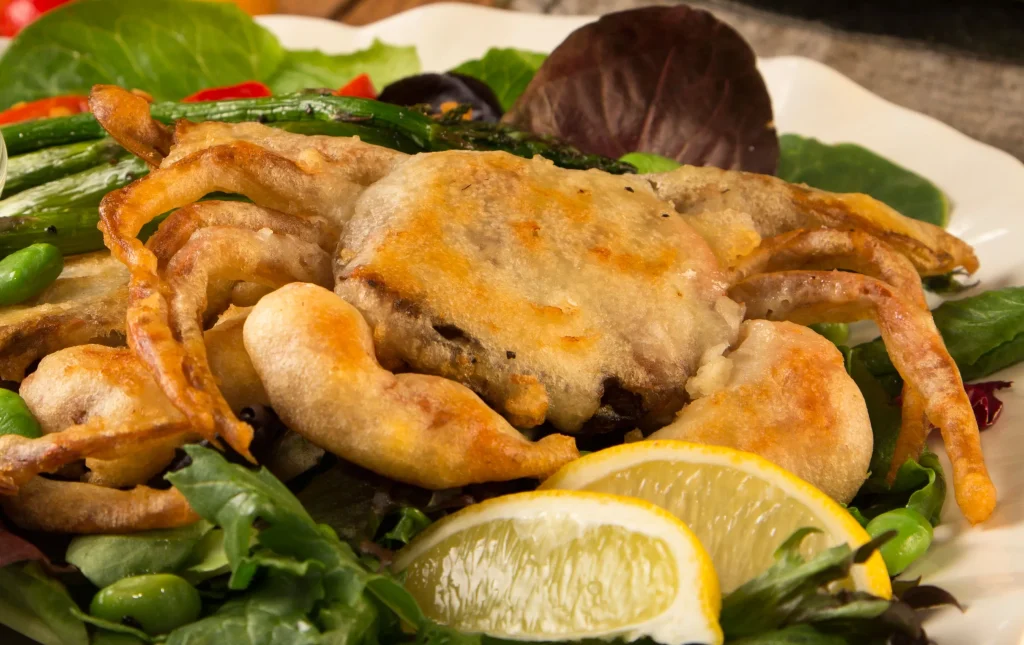
It’s a longtime seafood industry, but still not widely known to the public: soft-shell crabs. Consumers are familiar with the hard-shell crabs, but a surprising number – even some Cajuns – have not tried their soft edible versions.
In 2017, 10,865 pounds of soft-shell crabs were produced in Louisiana. According to LSU AgCenter, since the 1990s, the number of producers of soft-shell crabs in the state has gone from an estimated 300 to fewer than 40 today, likely because it’s a labor-intensive process. It’s also the main reason, a soft-shell crab is worth seven times the value of a regular blue point crab, according to a specialist at LSU AgCenter and Sea Grant.
While all crabs shed their outer shells to grow, only a few species can be eaten in this form, and the blue crab found in the Gulf is the most prevalent. During their lifespan (usually around three years) crabs will shed 20 to 21 times. As they grow, their shells cannot stretch, so they must molt their shells to grow.
Soft-shell crabs are caught in nets in the same way as hard-shelled ones. Crabber shedders (who farm soft-shell crabs) sort them out keeping those of legally harvestable size (five inches in shell width) identified by the red line that foretells the crabs will soon shed their shells.
Hey Buster!
Crab shedding is a full-time job. It’s been compared to having a newborn baby, checking on them in tanks every four hours around the clock. The soon-to-molt crabs are placed in filtered water, temperature-controlled shedding tanks. As soon as the “busters” wiggle their legs, making their “happy dance,” and back out of their shells, they swell with water and become visibly larger. A 4-1/2-inch crab becomes a 6-inch crab after it molts.
The busters are soft for only about two to three hours before a new shell starts to harden again. Once molting crabs are spotted, they are immediately removed from the water, to help stop the process, then put in crack trays and immediately rinsed, cleaned, and frozen for distribution. Freshly dead soft-shell crabs have a shelf life of four to five days with proper refrigeration.
Clawsome Crab Facts
-Blue crabs are one of the few marine organisms that mate and spawn at different times. The only time that a female will mate in her life is when she molts, but she can store the sperm to fertilize the eggs of future spawning.
-Crabs are fierce predators and cannibals. One study found that about 19 percent of their diet is other crabs. However, they stop eating just before molting, so the entire soft-shell crab body, organs and all, is very clean.
-Because crabs are cold-blooded, they are less active in cold weather, and won’t feed as much. Though the most productive months for the crustaceans are May through September, they can be caught March through November, but are available flash frozen to your door year around via LouisianaDirectSeafoodShop.com
Nutrition Value
A 4-ounce raw soft-shell crab contains approximately 80 calories, less than 1 gram of fat, no carbohydrates, and 20 grams of protein, along with an abundance of vitamins—providing 375% of your daily Vitamin B12 requirements and nearly half of your niacin needs. Indulging in soft-shell crabs is a guilt-free culinary choice!
Cooking
Whether a soft-shell crab is fried, sautéed, or grilled, you can eat the whole thing; the few non-edible parts have already been removed when you purchase them from Delcambre Direct Seafood.
When fried, soft-shell crabs are barely crunchier than fried shrimp. A favored way of cooking them is soaking them in an egg and milk mixture, which helps plump them up. Then dredge both sides in your favorite fish fry and fry them until light golden. Place them as the crown jewel on your Alfredo pasta or in a poorboy. C’est magnifique!
Recent Comments