

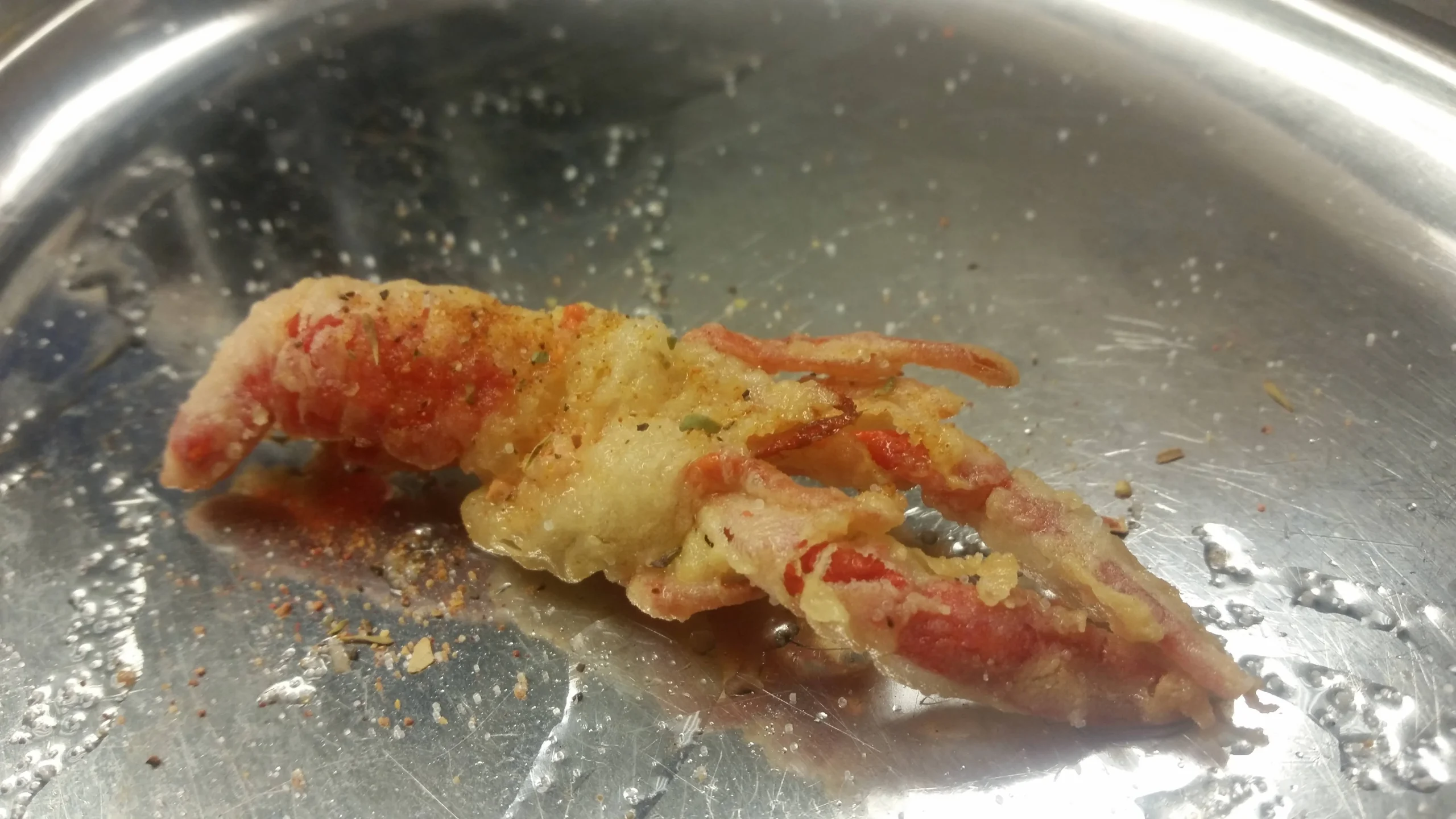
It’s amazing – the number of Cajuns who have never heard of soft-shell crawfish, given that soft-shell crabs are a popular menu item at many seafood restaurants.
To get past the first roadblock to enjoying soft-shell crawfish is to understand that you are not crunching down on a shell, and to understand that is to know the evolution of the soft-shell crawfish anatomy. Like soft-shell crabs, crawfish molt their hard shells. In the South, that usually takes place between April and June. The hard-shell splits between the head and tail on the back side, and the softshell crawfish usually separates from it by “tail flipping.”
In the wild, crawfish molt twice a week until they are mature, which usually occurs 11 times. When they molt, they are very vulnerable to predators, so they bury themselves in mud for protection, often giving them a muddy taste.
Thanks to L.T.E., Inc., the last remaining softshell crawfish plant in Louisiana, the process is more controlled and quicker—with crawfish molting once or twice—resulting in a better product. From the time the crawfish are brought to L.T.E.’s from the Spillway to the time they shed, it takes two to five weeks. (A full moon usually speeds the process.)
At the facility near Ethel, LA, owner Todd Edmonds takes 50 to 60 (35-lb.) sacks of live crawfish still growing, sorts and cleans them, and divides them up into some 300 trays where crystal-clear water is circulating. After the second day, they are fed shrimp food daily until they are pre-molts.
Every day, around the clock, the pre-molts are handpicked from the others and placed in separate bends, so that they don’t get what Edmonds calls “leather shell.” The molting bends are run every three hours and the crawfish are then placed in 34-degree water to stop their shells from further hardening. Crawfish shed most at the warmest part of the day, with the process taking only a few minutes. As soon as the crawfish leave their shells, they are gathered and cleaned. Everything but the head and two tiny balls of calcium behind the eyes (called the pearls) can be eaten. Excess fat is removed (because fat doesn’t freeze well.) At this point, they can be eaten whole. To assure freshness, the soft shells are sealed, vacuum packed, and immediately frozen.
As an appetizer, soft-shell crawfish make a delicious conversation starter, but they’re every bit as good in a po-boy or as the crown on top a bed of crawfish fettucine or etouffee. In any case, they are best fried. In addition to being tender and succulent, soft-shell crawfish are surprisingly sweeter than their hard-shell counterpart. The sweet/salty taste, combined with the batter, makes it love-at-first-bite for many first-timers.
You can purchase these delicacies through DelcambreDirectSeafood.com, sold 24 to a pack and ready to cook. To make sure you enjoy your eating experience, we offer this simple recipe.
Fried Softshell Crawfish
Whisk (3) egg whites and a little milk. In a separate bowl, combine 1 cup of flour, 1 cup cornmeal, ½ tsp. salt and your favorite Cajun seasoning (to your taste). Dip each crawfish in the egg mixture and then dredge in the flour mixture. Deep fry in hot vegetable oil for 2 to 3 minutes. Drain on paper towels and serve.
Recent Comments